Episode 7
PAUL

Previously in this series:
Episode 2: Christian and Latifa
“GOOD luck!” the pilot said, after the plane landed.
Rwandan opposition figure Paul Rusesabagina had just woken up from what appeared to be deep drug-induced sleep. He was on board a chartered jet that he thought had just flown him to Burundi to deliver a series of lectures on the 1994 Rwandan genocide.
It is a topic on which he is the world’s most eloquent and in-demand speaker, having sheltered terrified Tutsis from murderous Hutu mobs in the hotel he managed in Kigali, the capital. The story inspired the critically acclaimed Hollywood movie Hotel Rwanda, turning Mr. Rusesabagina into a modern-day Oskar Schindler.
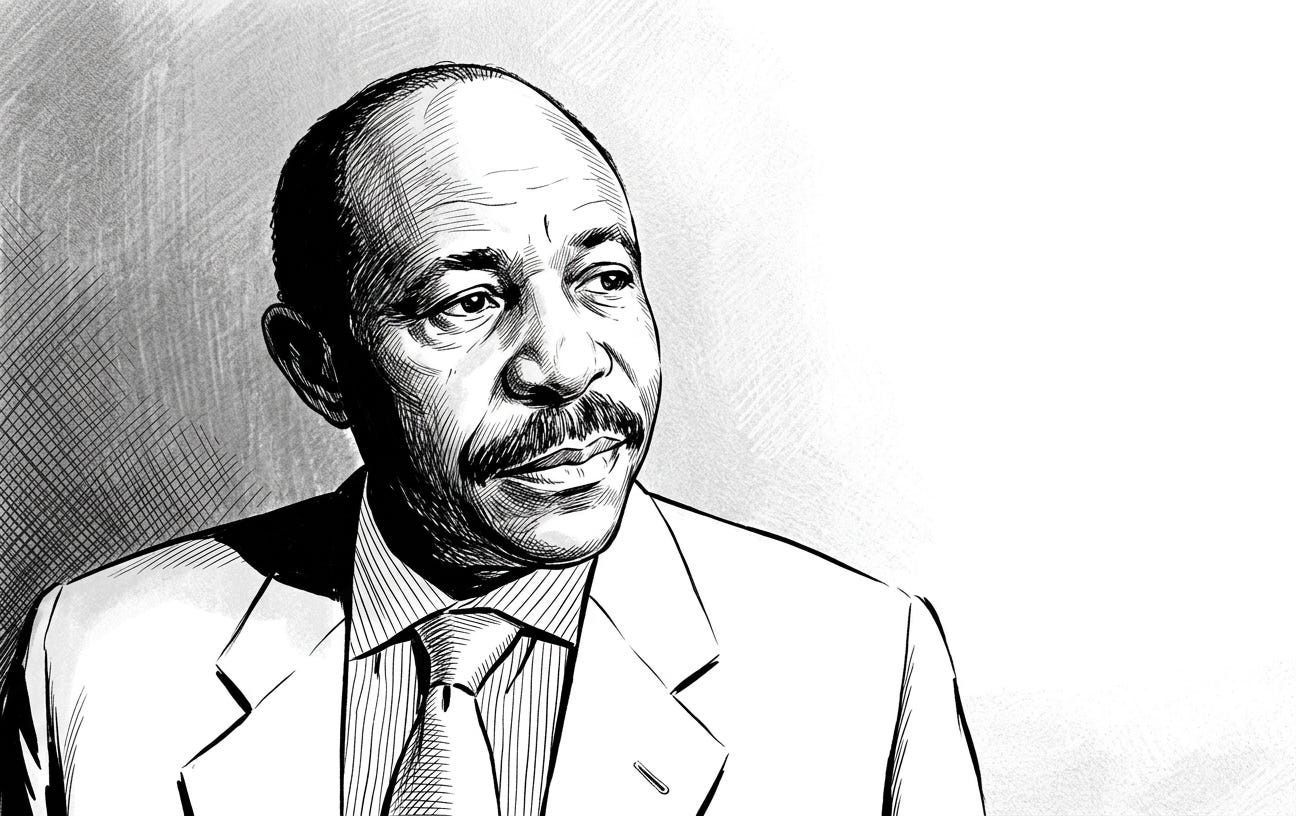
But while he is celebrated in the West, he is reviled by Rwanda’s longtime strongman Paul Kagame who has called him a fraud and a terrorist, and has vowed to hunt him down. As a result, Mr. Rusesabagina hadn’t set foot in his native Rwanda for more than two decades.
Until—he now realized—this very moment.
The private jet he was on had just landed not in Burundi but, inexplicably, at Kigali International Airport. In panic, Mr. Rusesabagina began to scream and tried to bolt from the plane. But it was too late. “Four Rwandan agents then entered the plane, tied his hands and legs, covered his face, and dragged him across the tarmac into a car—all in plain sight of the flight crew,” according to a lawsuit he later filed against the airline.
It was at this point that the Greek pilot wished him good luck.
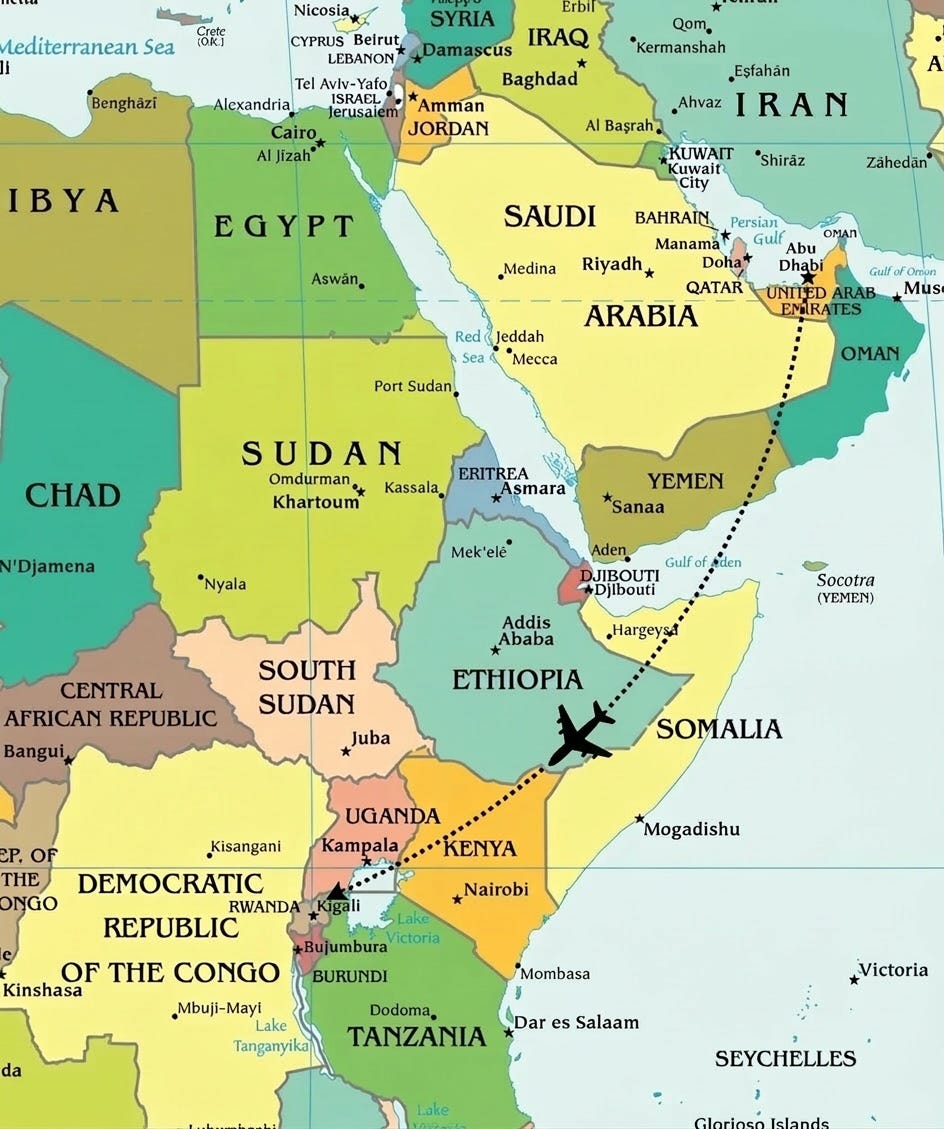
How Mr. Rusesabagina ended up jailed and tortured in Kigali is a story that transits through Dubai, which was the origin point of the private flight that surreptitiously delivered the activist to the Rwandan president hell-bent on his destruction.
And although the UAE has flatly denied any involvement, it is reasonable to ask whether Emirati security services may have had advance knowledge of the operation. The Greek chartered jet sat on the tarmac in Dubai for nearly 10 days waiting for Mr. Rusesabagina to walk into the trap.
“My guess is (the Emiratis) turned a blind eye to it,” says Brian Endless, an Africa scholar, a friend of Mr. Rusesabagina, and the president of his Hotel Rwanda foundation. Mr. Endless was involved in the international effort to investigate what happened to the Rwandan activist and to try to get him freed. There’s no smoking gun, and the case for the Emiratis’ possible advance knowledge of the abduction is circumstantial, based in part on the historical closeness between the UAE and Rwandan security services.
The UAE suffered an embarrassment in 2010 when 26 Mossad operatives flew into Dubai on various flights using European and Australian passports, immobilized and suffocated a visiting Hamas weapons buyer in a nearby hotel, and then swiftly flew out undetected. The operation prompted Emirati security services to roll out more cameras throughout Dubai, making it more difficult, though of course not impossible, for a multi-day foreign-intelligence plot of the kind that snagged the Rwandan activist to unfold undetected.
The events of the Arab Spring that saw several entrenched Middle Eastern regimes overthrown made UAE rulers particularly sensitive to domestic unrest and foreign meddling, and led to yet more surveillance capabilities being deployed in Emirati cities.
At the same time, the UAE appears willing to allow select foreign-intelligence operations to proceed on its soil if there’s a broader political agreement in place. In September, Ukrainian operatives extracted a Ukrainian member of parliament from his apartment in Dubai to face charges of treason in favor of Russia—in what the Ukrainian media described as a deal coordinated at a high level between Kyiv and Abu Dhabi.
A month before that, the UAE reportedly allowed Russian foreign-intelligence agents to grab a Russian banker in a Dubai mall, shove his wife aside, take him to the Russian consulate, and then fly him out to Moscow the next day to face charges of fraud and espionage. UAE authorities haven’t publicly commented on either case.
Whether or not there was a deal between Rwanda and the UAE on the abduction of Mr. Rusesabagina, the two governments and intelligence services have a very close relationship. The UAE accounts for the largest share of Rwanda’s overall exports. And there’s a murky side to that trade as well: UAE firms are reported to be among the principal intermediaries facilitating the trans-shipment of conflict minerals from Rwanda-backed rebels occupying gold and coltan-rich regions of the Democratic Republic of the Congo. This lucrative and illegal pipeline could only exist with at least a tacit approval of both countries’ security services.
Given the effort and the expense Mr. Kagame dedicated to capturing Mr. Rusesabagina, it is unlikely he would have left the key link of the plan—the secret Dubai-to-Kigali flight—exposed to the risk of disruption by an out-of-the-loop Emirati security agent. It is also hard to believe that Mr. Kagame would have wanted to jeopardize one of Rwanda’s most important strategic relationships by running an undeclared black op in the middle of the UAE’s glitzy gateway to the world.
There doesn’t seem to be any visible strain in the bilateral relationship: Sheikh Mohammed bin Zayed al Nahyan, the UAE president and the ruler of Abu Dhabi, met with Mr. Kagame at least five times around the time Mr. Rusesabagina was abducted in Dubai: a year and a half before the operation; and at least four times after the kidnapping.
One of those meetings occurred on Oct. 3, 2021 in the royal palace in Abu Dhabi, 11 days after Mr. Rusesabagina was given a de-facto life sentence at a show trial in Kigali. Attending the meeting with Mr. Kagame alongside the Emirati monarch was Ali al-Shamsi, one of the two most senior intelligence and covert-action officials in the UAE, and a central player in projecting Emirati influence in Africa and elsewhere.
There’s no evidence that Mr. Rusesabagina’s Dubai kidnapping came up at any of these meetings.
As the world’s two most famous Rwandans, the two Pauls could have been allies.
Mr. Rusesabagina, an ethnic Hutu, played a relatively small but courageous part in the genocide by saving the lives of about 1,200 Tutsis and moderate Hutus sheltering in his hotel. (Some 800,000 perished, hacked into pieces or clubbed to death–or shot, if they were lucky–in a three-month spree, which Mr. Rusesabagina describes as the fastest genocide in history). Through the movie and the subsequent book, he created a resonant narrative that helped establish the tragedy and its universal human themes in the global collective memory and in pop culture, much like Anne Frank’s Diaries did for the Holocaust.
Mr. Kagame, an ethnic Tutsi, actually ended the genocide by leading the military assault against the extremist Hutu regime in Kigali. He also led the post-war reconstruction and economic resurgence of Rwanda, while consolidating political control, muzzling dissenting voices, and launching a proxy war against the mineral-rich neighboring Democratic Republic of the Congo.
Concerned for his safety, Mr. Rusesabagina left Rwanda in 1996 and obtained political asylum and later citizenship in Belgium. There were threats to his life both in Rwanda after the genocide, and later in Belgium. He eventually settled in San Antonio, Texas, and became a U.S. permanent resident, remaining one of the staunchest critics of Mr. Kagame. The exiled dissident kept his Brussels house and often traveled there.
When Hotel Rwanda hit the movie screens in 2004, Mr Rusesabagina’s public profile eclipsed that of the Rwandan president. He was no longer just a disillusioned emigre grumbling about dictatorship to a small circle of like-minded compatriots—he now had a Hollywood-buttressed global platform from which to blast Mr. Kagame.
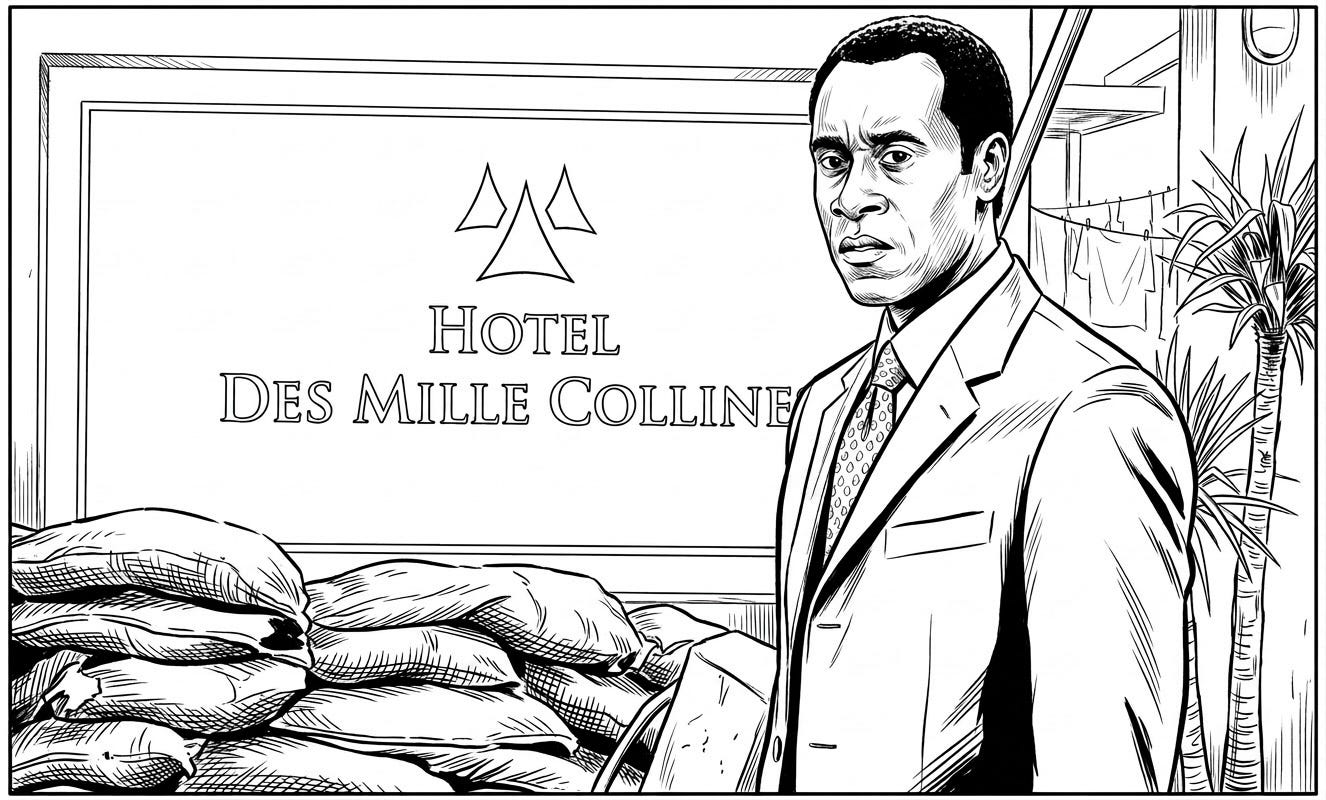
The Rwandan president counted Washington among his major allies. But it was the Rwandan dissident who received the Presidential Medal of Freedom from George W. Bush in a solemn White House ceremony in 2005.
By all accounts, Mr. Kagame was incensed by the film’s success. He suggested, without evidence, that Mr. Rusesabagina exaggerated his role as a savior of the Tutsis, and pro-government media aired invented claims that the former hotel manager had been extorting his terrified Tutsi guests. It must have rankled Mr. Kagame that the global accolades for heroism in the genocide were being heaped upon a Hutu, not a Tutsi.
In his 2006 memoir, “An Ordinary Man”, Mr. Rusesabagina called Mr. Kagame “the classic African strongman.”
The movie and the book paved the way for a public-speaking career, and Mr. Rusesabagina had regular paid speaking engagements at universities, churches, NGOs and corporate events around the world. Covid put an end to all that, and for the first time in years he found himself with nothing lined up.
And then an unexpected invitation rolled in. The source: a self-proclaimed bishop based in Burundi, who like Mr. Rusesabagina was a Rwandan exile with Belgian citizenship. The bishop, Constantin Niyomwungere, had been introduced to him by a mutual friend, so Mr. Rusesabagina had no reason to be suspicious. Since the introduction, the bishop spent some time trying to win the dissident’s trust and engage him in conversations about Rwandan politics.
Now Mr. Niyomwungere put a solid offer on the table: a fully funded speaking tour in Burundi, with a speaking fee plus airfare and accommodation. In the middle of covid lockdowns, this must have felt like a welcome break. Bordering Rwanda and sharing the same ethnic complexities, Burundi has a government that is at odds with Mr. Kagame’s regime, so Mr. Rusesabagina felt safe traveling there. And it’s as close as he could get to Rwanda—geographically, linguistically and culturally—which must have provided an added incentive for Mr. Rusesabagina who had spent a quarter of a century separated from his homeland.
The bishop was carrying out instructions from a Rwandan intelligence operative who asked him to spy on Mr. Rusesabagina and report back. The operative later authorized the Burundi ruse to lure the dissident to Kigali.
Rwandan agents have been known to infiltrate the inner circles of other influential dissidents in exile. In 2014, a former Rwandan intelligence chief who had turned against Mr. Kagame was strangled in a hotel room in Johannesburg, apparently by a person he knew and trusted.
For years, Mr. Kagame has cast Mr. Rusesabagina as a terrorist leader responsible for the killings of Rwandan civilians in attacks by a rebel group seeking regime change in Rwanda. Mr. Rusesabagina has denied endorsing attacks against civilians but there’s no question his political rhetoric grew more sharp-edged as Mr. Kagame tightened his hold on Rwanda. In a 2018 video address, Mr. Rusesabagina said “the time has come for us to use any means possible to bring about change in Rwanda.” The remark was seized upon by the pro-Kagame camp to portray Mr. Rusesabagina as a Malcolm X-style extremist, even though those who know him say he always rejected violence.
Rwandan authorities tried to get the Belgian prosecutors to go after Mr. Rusesabagina. The Belgians searched his house and spoke to him, but didn’t bring any charges. It appears that at that point Rwandan officials put in motion the abduction plan involving the cloak-and-dagger bishop. Mr. Kagame later described the operation as “flawless.”
On the evening of Aug. 27th, 2020, Mr. Rusesabagina flew into Dubai International Airport on an Emirates flight from Chicago and cleared customs and immigration. He went to a local Ibis hotel to get a couple of hours of rest. There, he met with the Burundi bishop, who had arrived in Dubai earlier to wait for the Rwandan activist. Later that same evening, the two checked out of the hotel and went to al Maktoum airport, about 30 miles away. The smaller airport is often used for private flights.
At al Maktoum, a small aircraft had been sitting on the tarmac for nine days, awaiting its two passengers and behaving erratically. Its operator, a Greek carrier called GainJet, changed the proposed departure date several times, abruptly cut back the crew size to a bare minimum, and never explained why the plane should remain grounded, according to legal discovery that emerged in subsequent litigation. GainJet collected passenger information only “hours” before the flight, which appears to violate UAE’s civil-aviation rules that require a notice of at least “two clear working days” about the identities of the travelers and their destination.
The Rwandan dissident and the Burundi bishop were the only passengers on the GainJet flight. Both the pilot and a flight attendant told Mr. Rusesabagina that they were heading to Burundi, and the Rwandan exile soon fell into a deep sleep that lasted almost the entirety of the 6-hour flight. Mr. Rusesabagina, who rarely sleeps on planes, later suspected that sometime before or on the flight he had been drugged to dull his senses and stifle unnecessary questions.
After his rendition to Kigali, the Rwanda Investigation Bureau hailed unspecified “international cooperation” that paved the way for Mr. Rusesabagina’s capture, a claim that was repeated by the country’s justice minister.
But Emirati officials pushed back against the notion that they were in any way involved in the rendition, or aware of it. Mr. Rusesabagina, they said, arrived in the UAE legally, stayed for about five hours, and then left legally, of his own free will, and was never detained, coerced or otherwise manipulated by the Emirati authorities. The UAE foreign ministry didn’t reply to my emails. After the UAE’s public denial, Rwanda changed its original explanation of what happened to Mr. Rusesabagina, dropping any mention of international help.
GainJet, the Greek carrier often used by the Rwandan government, didn’t respond to requests for comment. A judge in Texas last year allowed Mr. Rusesabagina’s lawsuit against the airline to move forward, dismissing GainJet’s claim that Texas, the Rwandan exile’s home state, has no jurisdiction in the matter.
After landing and getting arrested in Kigali, Mr. Rusesabagina was subjected to torture, which included a particularly painful hog-tied position designed to put pressure on the spine and the ribs. Unless untied, the victim can suffocate.
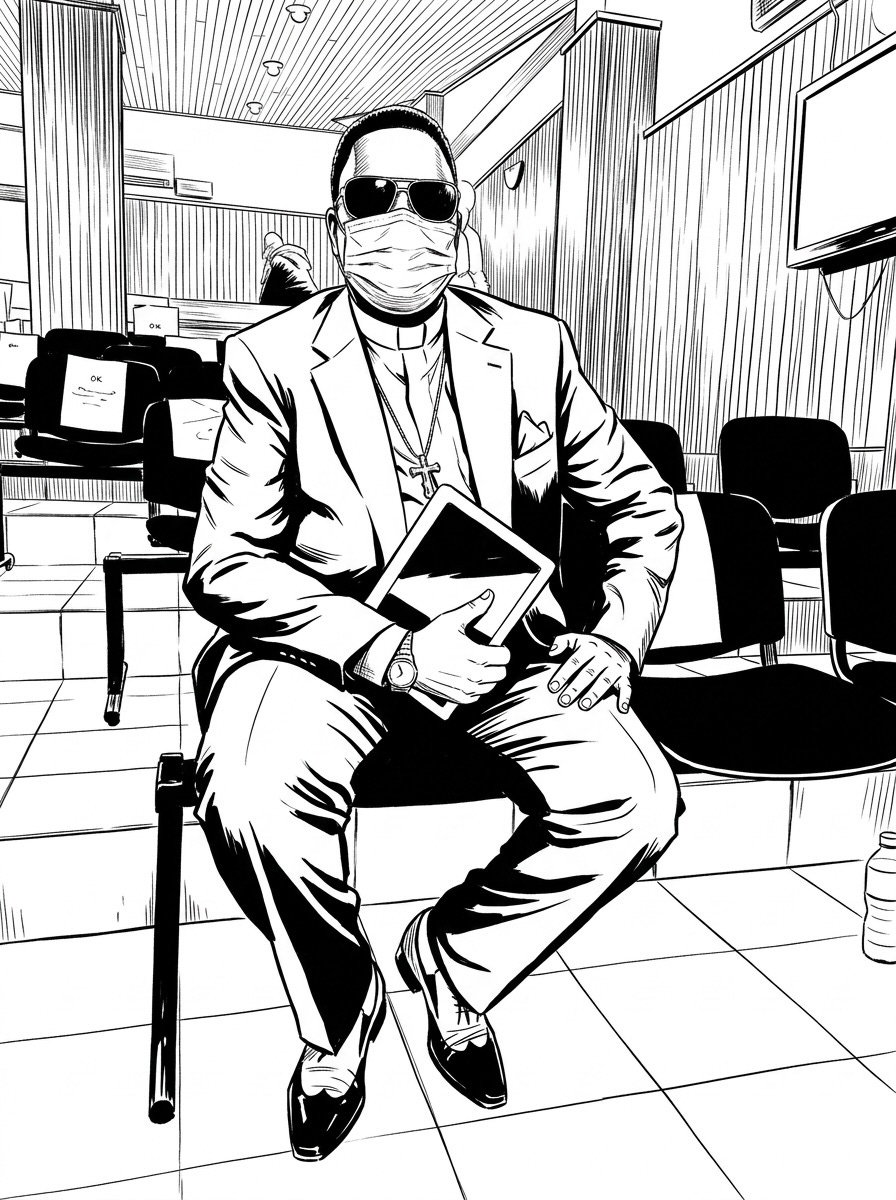
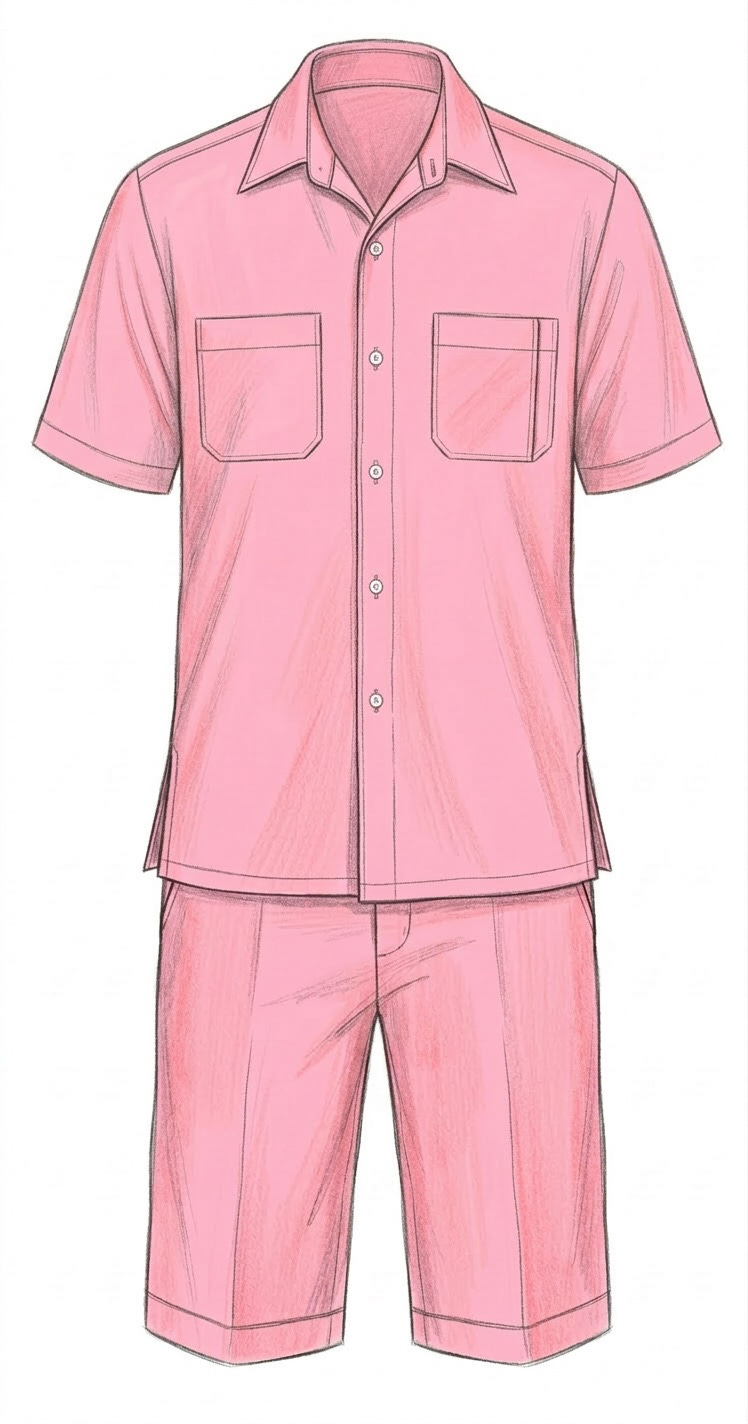
“We know how to torture,” one interrogator told Mr. Rusesabagina, pressing his boot down on his neck, according to a UN report on the case. After a year in solitary confinement, the dissident was sentenced to 25 years in prison for terrorism. At one point during the sham trial, the Burundi bishop showed up to testify wearing a white clerical collar, a large crucifix, massive aviator sunglasses and polished two-toned wingtips. He relished the success of the abduction, and said he was guided by God, and by Rwandan intelligence. In a scene worthy of Wes Anderson, Mr. Rusesabagina sat in the dock wearing a standard-issue Rwandan inmate uniform: a hot pink t-shirt and matching long shorts.
Mr. Kagame released him and let him leave Rwanda after three years in prison, in part as a nod to the U.S. The dissident is still recovering from the ordeal.
Thank you for reading. This is the end of the 7-part series. If you missed previous installments, you can find links to them here, or at the top of this episode. They are all stand-alone narratives that can be read independently of each other, though it does help to start in the beginning. If you liked this series, please share it with others. Your comments are always welcome. This Substack will return in a couple of weeks with other occasional essays and overlooked international stories, but not at the crazy daily pace of this series. Please consider subscribing. Thank you again for your time
-Philip